
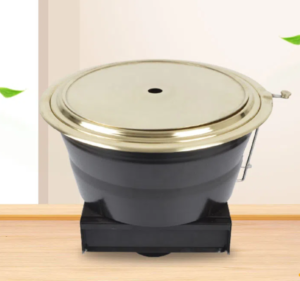
Calculation scope: The numerical values below are illustrative assumptions for explaining a method, not a tested MEDA system or a completed ventilation design.
Many restaurant owners consistently discover after opening their Japanese & Korean BBQ restaurants that poor BBQ exhaust performance fills the dining area with choking smoke, ruins customer experience, and hurts revenue. They then approach us, requesting assistance in diagnosing the root causes and proposing corrective measures.
We are the supplier of Japanese and Korean BBQ exhaust fan and Korean BBQ exhaust pipe, and many restaurant owners and construction teams ask which power rating to choose for the centrifugal fan for the ducting.
It is perfectly normal for restaurant owners not to understand indoor BBQ ventilation design. However, we are surprised that many construction teams also lack this knowledge.
Duct size, routing, fittings and installation details affect resistance, noise and smoke capture. Review the complete layout rather than choosing a main fan by motor rating alone.
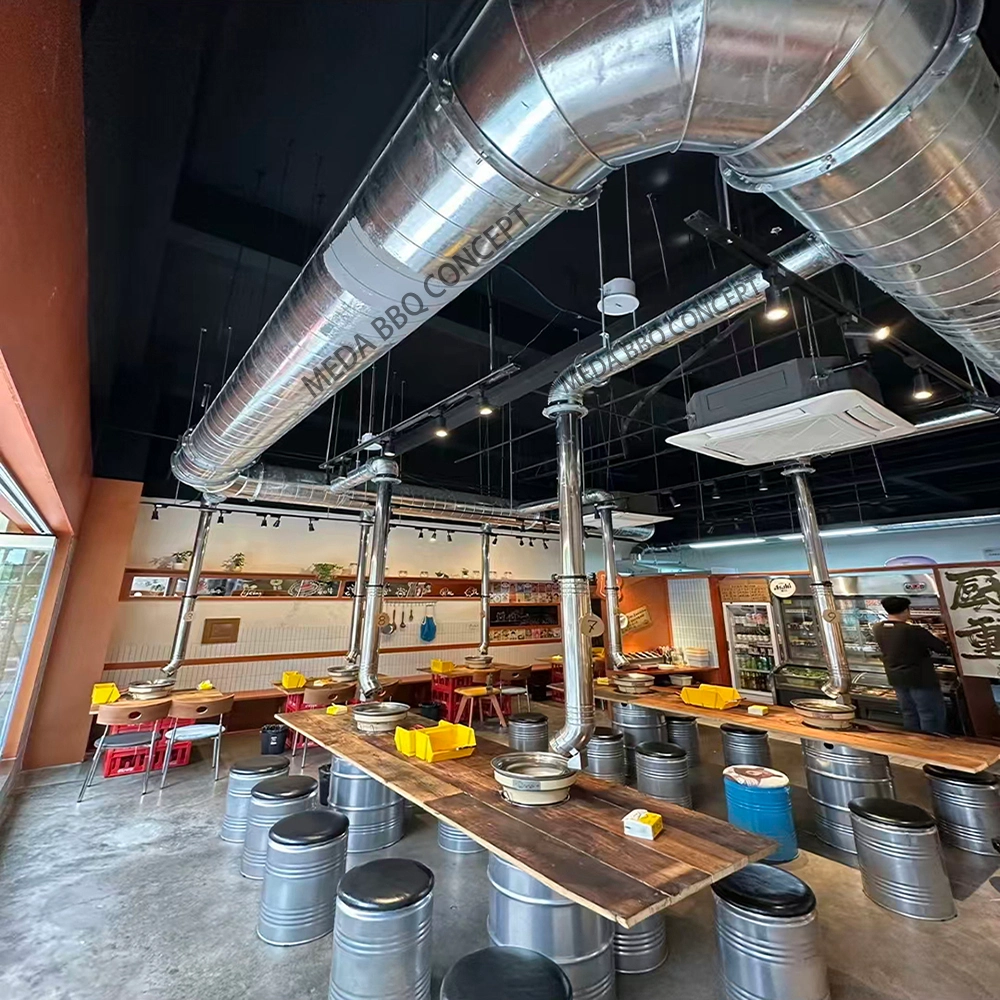
Some construction teams install centrifugal fan with mismatched power ratings, design excessively long ductwork, or use overly long retractable Korean exhaust pipes, causing smoke and fumes to fail to exhaust entirely.
Today, let’s analyze how to choose a centrifugal fan for the Korean BBQ ventilation in Korean and Japanese BBQ restaurants.

What determines the power of the centrifugal fan?
The power of the centrifugal fan depends on the total exhaust airflow (Q), the fan efficiency, the transmission efficiency, and the total pressure loss (P) in the Korean BBQ ventilation system.
For airflow Q in m³/h and total pressure rise P in Pa, the illustrative motor shaft-power estimate is Q × P / (3600 × fan efficiency × transmission efficiency), in watts. Motor electrical input also depends on motor efficiency. Keep the pressure definition consistent with the manufacturer’s fan curve.
Total airflow determines the extraction capacity for smoke; total pressure must be sufficient to overcome the system resistance.
How do you calculate the total exhaust duct airflow?
For the worked example, assume 500 m³/h per grill. This is an example input, not a universal airflow requirement: the actual value depends on the appliance, capture arrangement, installation and applicable project requirements.
For 10 grills at the assumed 500 m³/h each, the example total airflow is Q = 5000 m³/h. Confirm the design airflow for each branch and the overall system with the project designer.
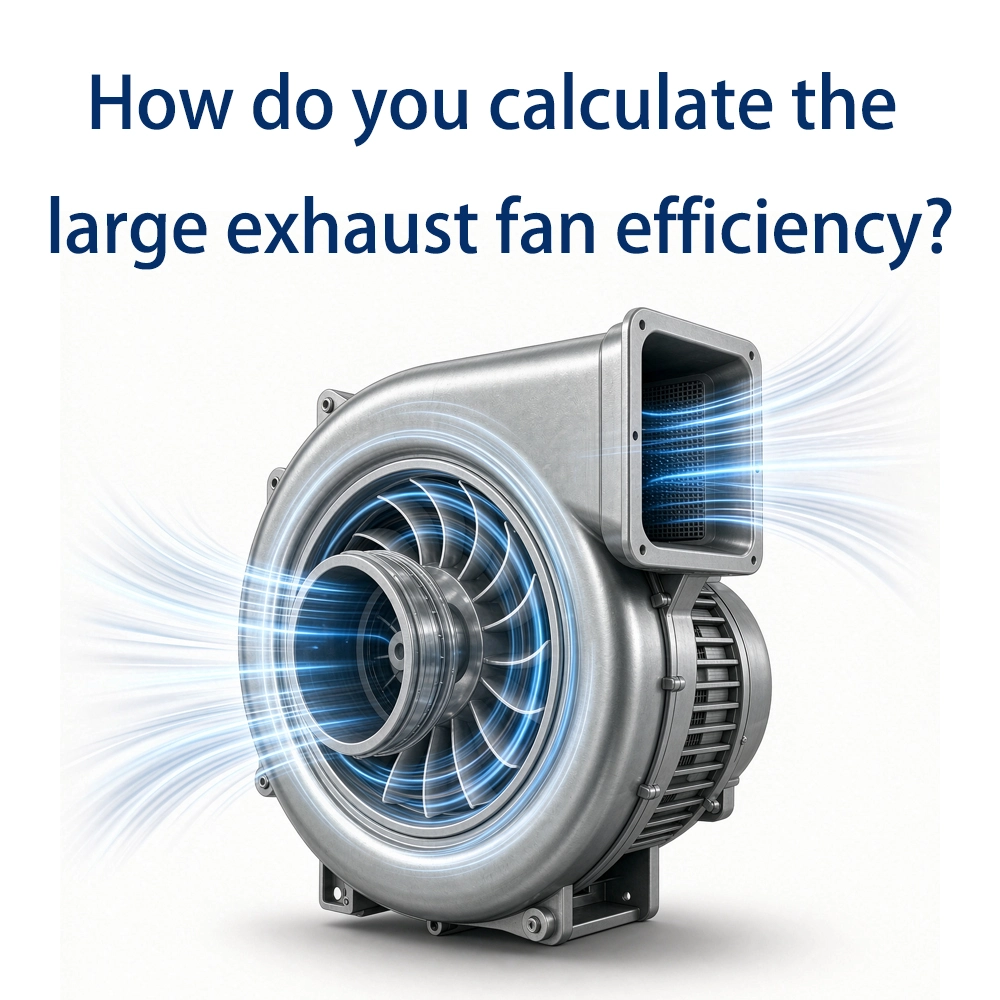
How do you calculate the large exhaust fan efficiency?
The efficiency data of a centrifugal fan is obtained from its performance curve, which the manufacturer supplies with each unit.
The curve plots airflow (Q) on the horizontal axis and pressure (P) on the vertical axis, with superimposed efficiency contours.
If you need assistance reading the curve, please forward it to us, and we will calculate the efficiency for you.
Use the manufacturer’s efficiency at the selected operating point. For arithmetic illustration only, this example assumes fan efficiency of 0.75; it is not a guaranteed efficiency for an unspecified fan.
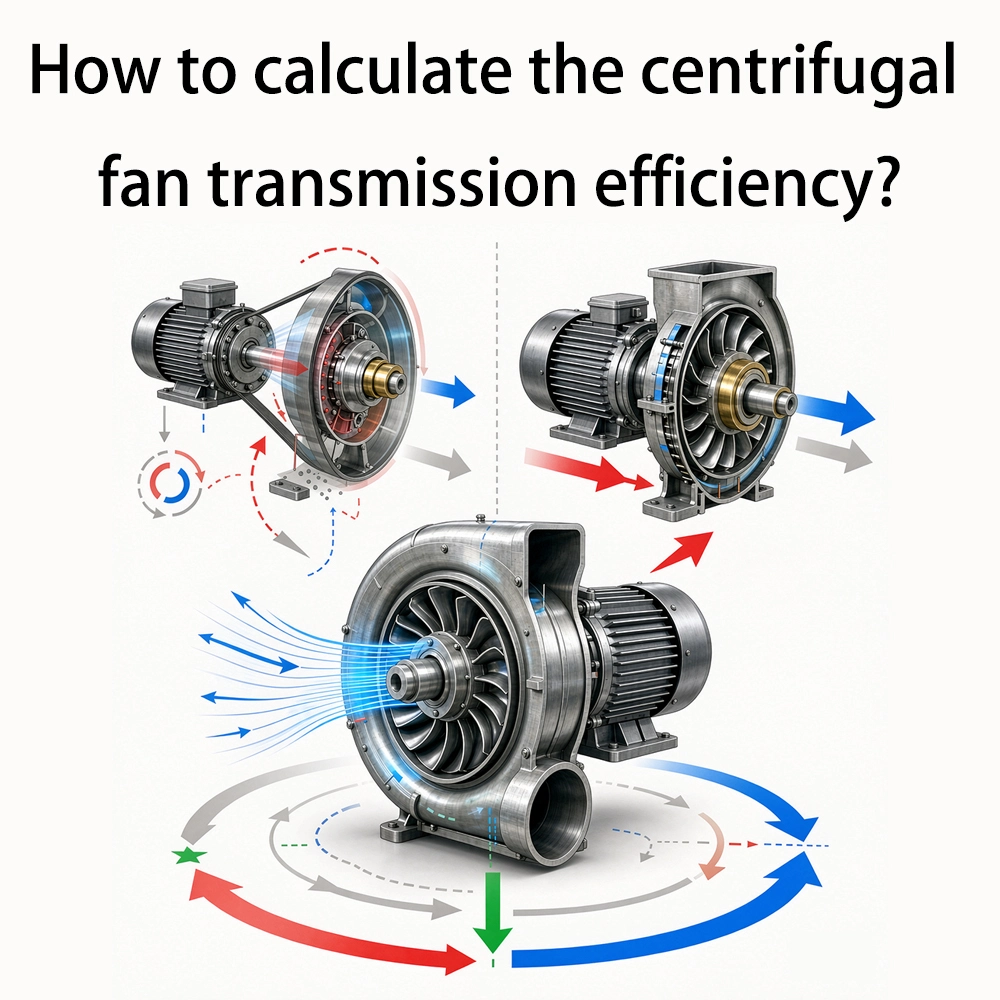
How to calculate the centrifugal fan transmission efficiency?
The transmission efficiency of the big extractor fan is governed by the coupling method between the motor and impeller. This varies with the mechanical design.
Should you require assistance in identifying the fan configuration, please forward the relevant data to us. A transmission efficiency of 0.95 is assumed in the power calculation.
How to calculate the duct pressure loss?
Total pressure loss (P) depends on many factors, such as duct friction loss, duct length, number of outlets, elbow types and counts, reducing elbows, grease purifier pressure drop, and retractable pipe pressure drop.
Total pressure loss (P) = duct friction loss + losses through elbows (type and quantity) + tee (straight-through) loss + reducer loss + outlet loss + grease purifier pressure drop + retractable BBQ smoker exhaust pipe pressure drop. (Add losses for any other in-line equipment as applicable.)
Duct friction loss
For this worked example only, assume a straight-duct friction loss of 1.0 Pa/m. Obtain the actual value from a duct calculation using the dimensions, airflow, material and surface condition.
Air velocity alone does not determine duct friction loss. The example value must not be applied as a general rule for all ducts operating at 10–12 m/s.
If your main duct total length is 15 meters, then the friction loss in the duct equals 15 m × 1.0 Pa/m = 15 Pa.
Pressure drop at the main duct outlet
Outlet losses depend on the discharge geometry and velocity. Calculate them for the actual outlet instead of assuming they are always equivalent to a fixed length of straight duct.
The arithmetic example below assumes an outlet loss of 4 Pa. This is a placeholder to show how losses are added; it is not a recommended design value.
Pressure drop from elbows
Each time the airflow turns a corner or changes cross-sectional area, it impinges on the duct walls, creating substantial pressure loss. Thus, every elbow contributes to the total pressure drop.
Thus, minimize the number of elbows in the duct design, and use 45° elbows or long-radius 90° elbows to reduce pressure losses.
The calculation of elbow pressure loss is complex and is therefore not detailed here for simplicity.
Common elbow types include 90° round elbows, 45° round elbows, tee (straight-through) fittings, pipe reducers, and elbow reducers.
For the arithmetic example only, assume 7 Pa per elbow and three elbows along the selected path. Actual fitting losses depend on geometry and local velocity and should come from the project calculation or fitting data.
Pressure drop from the main duct grease purifier
Filters and purifiers can contribute significantly to system resistance. Obtain pressure-drop data at the intended airflow from the equipment manufacturer.
This example assumes 250 Pa across the purifier. It does not claim that this is the normal pressure drop for every electrostatic purifier.
Check both the clean and permitted operating condition of the selected equipment, and include its specified maintenance limits in the design.

Retractable BBQ exhaust pipe pressure loss
This example assumes a 150 Pa branch loss for the selected retractable exhaust assembly. Use model-specific data at branch airflow. Parallel branch pressure drops are not simply added together; the controlling path and balancing arrangement must be evaluated.
Assume your Korean BBQ restaurant has a main duct 15 m long (along the path), with three 90° elbows, one outdoor exhaust outlet, and one grease purifier in the duct. And there are 10 BBQ grills and 10 retractable Korean exhaust pipe.
For the illustrative controlling path, add straight-duct loss, fitting losses, outlet loss, purifier loss and the relevant exhaust-branch loss once each. Include other components if present.
Total pressure drop (P) = main duct friction loss (15 Pa) + elbow loss (21 Pa) + outlet loss (4 Pa) + grease filter loss (250 Pa) + total pressure drop of retractable Korean exhaust pipes (150 Pa) = 440 Pa
Illustrative motor shaft power (W) = Q (m³/h) × P (Pa) / (3600 × fan efficiency × transmission efficiency).
Using the assumed inputs: 5000 × 440 / (3600 × 0.75 × 0.95) ≈ 858 W of motor shaft power. Electrical input is higher after motor losses. This calculation illustrates the method; it does not establish the required fan for a real restaurant.
Considering Practical Factors
Over time, the grease accumulate on the inner surfaces of the retractable Korean BBQ exhaust pipes, grease filters, main duct, and purifier, gradually increasing the system resistance.
Confirm the selected fan and motor against the manufacturer’s performance data, supply conditions and operating limits.
Select the fan by the required airflow and pressure on its performance curve, then verify motor loading and an appropriate operating margin. The 858 W example by itself does not justify choosing any particular 1.1 kW or 1.5 kW unit.
A compatible variable-frequency drive can provide speed control, subject to the fan and motor limits. Grease buildup or a blocked duct requires inspection and cleaning; increasing speed is not a substitute for maintenance.

What problems can cooperation with us avoid?
Send us the restaurant layout, equipment list and available ventilation information about the centrifugal fan so we can discuss suitable products and provide their specifications. Have the complete system design and installation reviewed by the responsible project professional.
ABOUT MEDA BBQ CONCEPT
We manufacture Japanese and Korean BBQ smoke extractors, barbeque grills, BBQ tables, and smokeless hot pot tables. With over 10 years of experience spanning production, design, sales, and after-sales service, we go beyond equipment supply—we deliver complete, custom-tailored exhaust solutions to our customers.
Contact Us
Email: [email protected]
WhatsApp: +8618138505729
Website: www.medabbqconcept.com
Reference and calculation basis
The U.S. Department of Energy fan-system sourcebook discusses fan curves, system resistance, efficiency and operating points. It supports the general selection approach, not the restaurant-specific numerical assumptions used in this example. Use the selected equipment’s current performance data for a project.